Have you ever wondered why your perfume doesn't last as long as it did the first time you wore it? Or why the same scent smells completely different on you than on your friend? Chances are you're making one or more of the classic perfume mistakes that most of us have made.
Let's be honest - perfume isn't cheap, and there's nothing more frustrating than investing in a scent you love, only to discover it vanishes after a couple of hours. But the good news is that with a few simple adjustments, you can get much more out of your perfume collection.
In this guide, we'll cover the five most common mistakes people make with perfume, and - more importantly - how you can easily fix them. After reading this, you'll make your perfume last longer, smell better, and save money in the long run.
Mistake #1: You store your perfume in the bathroom
This is perhaps the most common mistake, and it can ruin even the most expensive perfume over time. Many of us have a neat arrangement of perfume bottles standing on the bathroom counter or in the bathroom cabinet. It looks nice, and it's convenient to have your perfume where you get dressed in the morning. But here's the truth: the bathroom is actually the worst place you can store perfume.
Why this is a problem
Perfume is surprisingly sensitive to three things: temperature fluctuations, humidity, and light. Your bathroom has all these factors in abundance. Every time you shower, the temperature and humidity rise dramatically. These fluctuations break down the fragrance molecules in your perfume faster than you think.
When perfume is exposed to heat and humidity over time, the fragrance oils begin to oxidize. This not only changes the scent (often for the worse) but also significantly reduces its shelf life. You might notice that your perfume starts to smell a little sour or strange after a few months in the bathroom.
How to fix it
Move your perfume collection to the bedroom, living room, or another room with a stable temperature. Ideally, perfume should be stored:
- In a cool, dry place (room temperature is perfect)
- Away from direct sunlight (drawers or closets are excellent)
- In its original packaging if possible (the boxes protect against light)
- Upright (not lying down)
Some perfume enthusiasts even store their most exclusive scents in a cool wardrobe or drawer. This might feel unusual at first, but the difference in longevity is remarkable. A well-stored perfume can remain perfect for 3-5 years or more.
A simple tip: Only bring the perfume you plan to use that day into the bathroom, and return the bottle to the bedroom afterwards. Or keep a small decanter bottle (sample bottle) in the bathroom that you refill from the main bottle monthly.
Mistake #2: You rub your wrists together after application
This motion is so ingrained that we barely think about it. You spray perfume on both wrists, rub them vigorously together, and maybe dab a little on your neck. It looks elegant, and it feels like you're distributing the perfume evenly. But this motion actually does more harm than good.
Why this is a problem
When you rub your wrists together after spraying perfume, you create friction and heat. This might sound positive – heat helps perfume develop, right? But the problem is that this rubbing actually breaks down the top fragrance notes before they have a chance to develop naturally.
Perfume is built in layers: top notes, heart notes, and base notes. Each phase should develop gradually over hours. When you rub the perfume in, you effectively force all these phases to activate simultaneously. The result? The scent becomes flatter, less complex, and fades faster.
It's like watching a movie on fast-forward – you get the story, but you miss all the nuances that make it special.
How to fix it
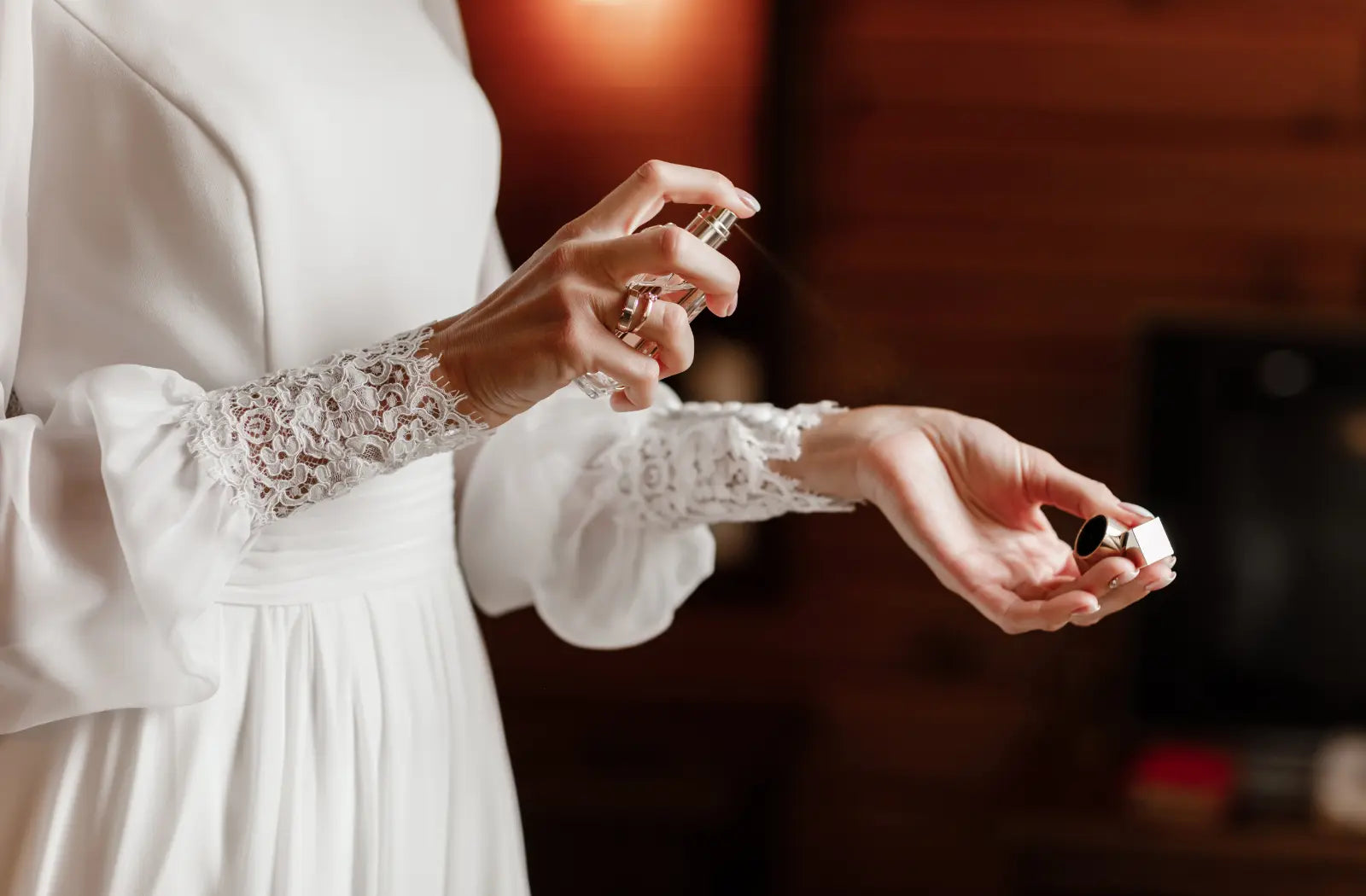
The solution is simple but requires a little self-control: Let the perfume dry naturally on your skin without touching it.
Here's the correct technique:
- Spray perfume on the desired spot (wrists, neck, etc.)
- Hold your arms slightly away from your body for 10-15 seconds
- Let the perfume air dry completely without touching it
- If you absolutely must do something, gently dab with a flat hand – DO NOT rub
This simple change will allow your perfume to develop as it was intended. You'll notice that the scent lasts longer, changes more interestingly throughout the day, and gives you the full fragrance experience you paid for.
Many find it difficult to resist the urge to rub at first. One trick is to spray perfume first, and then immediately do something else with your hands – like putting on jewelry or styling your hair – so you're not tempted to touch your wrists.
Mistake #3: You use either too much or too little
Perfume dosage is a tricky balancing act. If you use too little, neither you nor others will notice the scent. If you use too much, people will be asked to keep their distance. Both extremes are problematic, but for different reasons.
Why this is a problem
Using too much perfume is perhaps the most obvious problem. We've all met that person in the elevator who smells so strong it takes your breath away. It's unpleasant for others, and you're literally throwing money out the window by using more than necessary.
But here's a lesser-known fact: when you wear perfume every day, your nose gets used to your scent. This is called "olfactory fatigue" or scent blindness. You simply stop noticing your own scent as strongly. This leads many people to gradually increase the amount of perfume they use because they think the effect has weakened. In reality, you smell just as strong as before – you just don't notice it yourself.
Using too little perfume is a less obvious problem, but also common. Maybe you're afraid of becoming "the perfume person," or maybe you're trying to make an expensive bottle last forever. Whatever the reason, if the perfume is so weak that only you can smell it when you bring your wrist all the way up to your nose, you're missing the whole point of wearing perfume.
How to fix it
The perfect dosage depends on several factors: the perfume's strength (EDT, EDP, oil perfume), the occasion, the season, and even your own skin type. But here's a good rule of thumb:
For eau de parfum (EDP) – the most common:
- Daily wear / office: 2-3 sprays (one on each wrist, one on the neck)
- Evening / party: 3-5 sprays (add behind the ears, on the nape of the neck, perhaps inner elbows)
- Summer: 2-3 sprays (heat amplifies perfume)
- Winter: 4-5 sprays (cold dampens perfume)
For Arabic perfumes and intense oud scents: Start with 1-2 sprays. These are more potent than Western perfumes and require less quantity.
For eau de toilette (EDT): Add 1-2 extra sprays compared to the EDP recommendations above.
A good test: Ask a trusted friend or family member if they can smell your perfume when they stand at a normal conversational distance (about one meter away). If they have to lean in to smell it, use a little more. If they smell it before they even reach you, use a little less.
Also remember that it's better to start conservatively and add more as needed, rather than overdo it and walk around all day like a walking cloud of scent.
Mistake #4: You spray perfume in all the wrong places
Most of us have learned to spray perfume on our wrists and perhaps on our neck. This isn't wrong, but it's not optimal either. There are actually strategic places on the body where perfume lasts longer and spreads better – and most of us don't utilize these spots.
Why this is a problem
Perfume works best in places where the skin is warmest, because heat helps the fragrance molecules develop and spread in the air around you. These places are called "pulse points" because blood vessels are close to the surface here, making the skin warmer.
But many people spray perfume in places like:
- The top of the wrists (where watches and clothes rub)
- The middle of the front of the neck (where scarves cover in winter)
- On clothes (which can cause stains and doesn't allow the perfume to develop properly)
- Just one single spot
When you only use one or two obvious spots, you don't get the full fragrance experience that comes from having the perfume surround you from multiple directions.
How to fix it
Here are the best places to apply perfume, prioritized by effectiveness:
The essential pulse points:
- Behind the ears – Exceptionally effective because the area is warm and close to your face. When people get close to talk, they will subtly notice the scent.
- Neck (back) – Perfect because the area is warm and the scent rises throughout the day.
- Inside of the wrists – A classic for a reason. Good distribution and you can enjoy the scent yourself.
Bonus spots for extra longevity:
- Inner elbows – A pulse point many forget, but it's worth its weight in gold on cold days when you're wearing a sweater.
- Behind the knees – Sounds strange? This is actually an old perfume trick from the haute couture world. Heat rises, so the scent rises from this point.
- Between the breasts – A warm area that holds perfume all day (avoid if wearing a bra that might absorb the scent).
Extra tips for maximum effect:
- Spray once in your hair (not too often, alcohol can dry it out)
- Apply to the wrist and gently dab on the ears – do not spray directly on your face
- For special occasions: spray a little perfume in the air in front of you and walk through the "scent mist"
Avoid spraying perfume directly on light-colored clothing as the alcohol can leave stains. If you want your clothes to smell good, spray on the inside of your jacket or spray into the air and let your clothes pass through the scent.
By strategically using multiple pulse points, you create a "fragrance aura" that lasts longer and smells better than if you only use one or two spots.
Mistake #5: You don't consider the season, occasion, and skin type
This is perhaps the most overlooked mistake, but it can make a huge difference in how your perfume is perceived. The same perfume can be perfect in winter but cloying and overwhelming in summer. It can be ideal for a party but completely wrong for the office. And the one that smells heavenly on your best friend might smell strange on you.
Why this is a problem
Many people find one perfume they love, and then use it every single day, all year round, for all occasions. This is a shame for several reasons:
Season affects how perfume is perceived:
- Heat significantly amplifies perfume. A heavy, sweet scent that is lovely in December can become nauseating in July.
- Cold dampens perfume. A light citrus scent that is perfect in summer can disappear completely in the winter cold.
- Humidity in the air also affects how perfume spreads.
Occasion affects what is appropriate:
- A powerful, sensual oud scent might be perfect for dinner at a restaurant, but completely wrong for a job interview.
- A discreet, clean scent is ideal for the office, but might be completely lost in a party venue.
Skin type affects longevity and scent:
- Dry skin holds perfume less well (fragrance molecules have less to cling to)
- Oily skin holds perfume longer and can amplify certain notes
- Your unique skin chemistry can make the same perfume smell differently on you than on others
How to fix it
You don't need a gigantic perfume collection to consider these factors, but you should have at least 3-4 scents to cover the basic needs.
Build a smart perfume wardrobe:
Minimum wardrobe (3 scents):
- A light, fresh scent – For summer, daily wear, office. Think citrus, green notes, light florals.
- A warm, cozy scent – For autumn/winter, evening. Think vanilla, spices, amber, oud.
- A versatile in-between – For spring/autumn, can be worn all day. Balanced between fresh and warm.
Ideal wardrobe (5-6 scents): Add an extra light summer scent, a statement scent for special occasions, and a clean, discreet scent for professional settings.
Adjust according to skin type:
If you have dry skin:
- Apply unscented body lotion first to give the fragrance molecules something to cling to
- Choose more concentrated formulations (EDP instead of EDT)
- Consider oil perfumes that last better on dry skin
- Moisturize your skin extra well after showering
If you have oily skin:
- You have an advantage – perfume naturally lasts longer on you
- But be aware that certain notes can be amplified
- Always test perfume on your own skin before buying
- You can get away with slightly fewer sprays than others
Seasonal guide:
- Spring (March-May): Light to medium intensity. Floral scents shine now. Think spring flowers, green notes, light fruitiness.
- Summer (June-August): Light and fresh. Citrus, aquatic notes, light florals. Stick to 2-3 sprays. Avoid heavy, sweet scents.
- Autumn (September-November): Medium to strong. Spices start to work. Fruitiness works well. This is the transition season where you can experiment.
- Winter (December-February): Powerful, warm scents. Now is the time for oud, amber, vanilla, and sweet gourmand scents. You can use more without it becoming overwhelming.
Invest in a varied perfume collection, and your fragrance experience will be so much richer. You'll smell good in all situations, and people will notice that you always have the perfect scent for the occasion.
Bonus tips: Make your perfume last even longer
Now that you know what NOT to do, here are some extra tips to maximize your perfume's longevity:
- Scent right after showering: Apply perfume immediately after showering while your skin is still slightly damp (but not wet). Pores are open and can absorb the scent better.
- Moisturize your skin first: Use an unscented body lotion before perfume. This gives the fragrance molecules something to cling to. Some even suggest using a drop of pure glycerin on pulse points before perfume.
- Layering: If your perfume comes with matching shower gel or body lotion, use them! This "layering" technique significantly amplifies and prolongs the scent.
- Spray on your hair – but gently: Hair holds perfume incredibly well. But the alcohol in perfume can dry out hair, so don't do this daily. Alternatively: spray on your hairbrush first, then comb through your hair.
- Perfume clothes (smart): Spray the inside of jackets, scarves, or sweaters. Textiles hold perfume for days. But never spray directly on silk or light fabrics that can stain.
- Carry a small sample bottle: Fill a small decanter bottle (2-5ml) that you can keep in your bag. Perfect for a quick refresh halfway through the day without wearing out your main bottle.
- Avoid rubbing clothes against the perfume: Let the perfume dry completely before putting on clothes. Friction from clothes breaks down the scent faster.
Summary: Small changes, big difference
Let's summarize the five big mistakes and solutions:
- Storing in the bathroom → Move to the bedroom, away from heat and humidity
- Rubbing wrists → Let the perfume air dry naturally
- Incorrect dosage → 2-5 sprays depending on type and occasion
- Wrong application spots → Use multiple pulse points strategically
- Ignoring context → Build a varied collection for different situations
These changes cost you nothing, but will make your perfume collection:
- Last significantly longer (save money!)
- Smell better throughout the day
- Develop as it was intended
- Be more suitable for different situations
- Make you smell fantastic without being overwhelming
Next time you put on perfume, take the time to do it right. Your body, your perfume, and everyone around you will thank you for it.
Have you made any of these mistakes? You're definitely not alone! Now you know how to easily fix them and get the most out of every single bottle in your collection.